
Buying signals: how to tell a company is ready now
Timing is half the sale. The main public buying signals, how to tell a strong one from a weak one, and what to do when you see it.

Your company may be a perfect fit for a customer, yet you reach out at the wrong time and hear nothing. Timing matters, and the good news is that many companies announce their needs without meaning to. We call these announcements buying signals.
The main public signals
| Signal | What it often means | Where to find it |
|---|---|---|
| A new branch or plant | New budget and operating needs | News and company pages |
| Hiring in one team | The team is growing or starting a project | Job posts |
| A tender or RFP | The need is public and the date is set | Tender portals |
| A funding round | A growth plan and spending ahead | Business news |
How strong is the signal?
- Is it recent? Two weeks old beats six months old.
- Is the source clear? An official announcement beats an unconfirmed post.
- Does it relate to what you sell? Hiring data engineers matters to a data-tools vendor, maybe not to an office-furniture one.
One strong signal beats five weak ones. Two signals on the same company in the same month usually deserve your time this week.
What to do when you see one
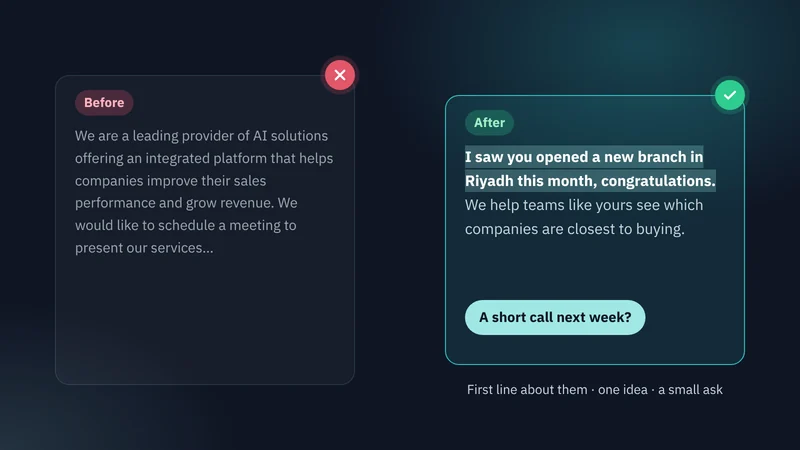
- Mention it kindly in your first line: “I saw you opened a branch in Jeddah.”
- Tie it to one problem that usually comes with that kind of change.
- Suggest a small step: a short call or a practical example, not a price list.
Avoid any awkward assumption. “I saw you are expanding” beats “you seem to struggle after the expansion”.
Know who to sell to now
Deloni reads public buying signals, ranks companies by readiness, and drafts a first message in your company’s voice.
Comments (0)
No comments yet. Share your view or experience.